We earn a commission if you buy through our links, at no extra cost to you.
Comparison
Best Dehumidifiers of 2026: Basement & Crawl Space
Five dehumidifiers ranked for 2026: AprilAire E080W and E070, AlorAir HD55S, plus two 50-pint pump models from Midea and hOmeLabs. Specs, drainage and fit.
B By the Best Dehumidifier editorial team ·Published
At a glance
For a crawl space, a big basement or a ducted install, the AprilAire E080W leads with 80 pints per day, according to AprilAire. The AprilAire E070 is the smaller drain-only step down. If you need a portable with a pump, the Midea Cube 50-Pint with Pump is the compact pick.
A dehumidifier is only as useful as its match to the space, so this ranking starts with how to read the numbers and then goes through five models in order: two AprilAire fixed units, one compact AlorAir utility unit and two 50-pint portables with built-in pumps. We rank on maker-published specifications, ENERGY STAR data and EPA guidance. We do not test the machines, and we say plainly when a maker leaves a figure out.
Humidity control is about equipment, not promises. The EPA says that controlling moisture is the key to controlling mold, that indoor humidity should stay below 60 percent and ideally sit between 30 and 50 percent, and that a leak must be fixed rather than dried around. A dehumidifier helps keep relative humidity in that range once the water source is dealt with.
How We Chose
Six criteria separate the models below.
Current DOE pints versus old labels. The DOE now tests at cooler conditions, and ENERGY STAR says the lower ratings started appearing in early 2020. The same hardware now carries a smaller number, which is why an older “70-pint” label and a current “50-pint” rating can describe similar machines. Compare current ratings with current ratings, and be wary of a box from before the change.
AHAM versus saturation. Crawl space units often quote a standard rating and a much higher “at saturation” figure that describes a warm, nearly saturated condition most spaces never reach. Use the lowest standardized number to plan.
Drainage and pump. A bucket fills fast at these capacities. A hose drains by gravity and needs a drain lower than the unit. A built-in pump moves water up to a sink or out a window. Fixed units often have no bucket at all.
Low temperature. ENERGY STAR says frost can form on a compressor dehumidifier’s coils when the air drops below about 65 degrees F, and that a unit specified for lower temperatures suits cool spaces. Look for automatic defrost or a published operating range.
ENERGY STAR. ENERGY STAR says certified dehumidifiers use about 20 percent less energy than similarly sized conventional units. The label is a useful tie-breaker, but not every maker page lists it.
Noise. Only a few makers publish decibel figures. A basement or crawl space tolerates noise, while a bedroom does not. We quote a figure only when the maker or a certifier does.
If your need is a bedroom, a closet or a bathroom rather than a basement, read our small dehumidifier ranking instead, since the models below are sized for large and damp spaces.
Summary Table
#
Model
Capacity (maker)
Drainage
Control
Cold-space notes
Warranty (maker)
1
AprilAire E080W
80 pints per day
Barbed fitting for hose or floor drain, no built-in pump
Wi-Fi and app
ENERGY STAR Most Efficient 2025
6 years
2
AprilAire E070
Up to 70 pints per day
Hose or floor drain, no tray
Digital control
Not published
Not published
3
AlorAir Sentinel HD55S
55 pints at AHAM, 120 at saturation
Gravity hose, no pump
Digital (Wi-Fi on a different version)
Auto defrost, 33.8 to 104 degrees F
6 years limited
4
Midea Cube 50-Pint with Pump
50 pints per day
Built-in pump or hose
App and voice
Not published
1 year
5
hOmeLabs 50-Pint with Pump and Wi-Fi
50 pints per day (120 at 95 degrees F, 90% RH)
Built-in pump, hose or bucket
Wi-Fi
Not published
1 year
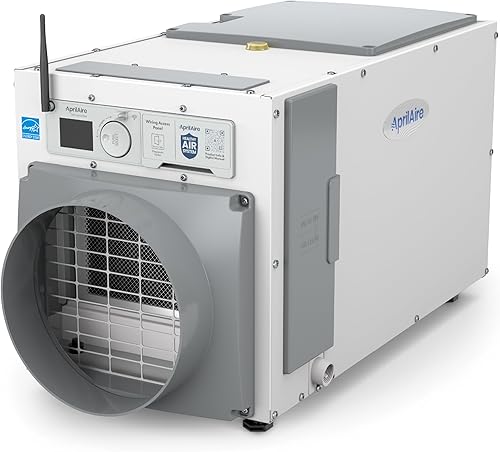
1. AprilAire E080W — The Whole-House and Crawl Space Heavyweight
The highest capacity here at 80 pints per day, with Wi-Fi, ducted layouts and a 6-year warranty, per AprilAire. It suits a sealed crawl space, a large basement or a whole-house install.
AprilAire lists the E080W at 80 pints per day for crawl spaces, basements and whole houses up to 4,400 sq ft. It adds built-in Wi-Fi with Bluetooth pairing, the Healthy Air App for alerts and diagnostics, a washable MERV 8 filter, R32 refrigerant and an ENERGY STAR Most Efficient 2025 designation. The warranty is 6 years: 5 years of full replacement plus 1 year on parts.
The ducting sets it apart. AprilAire lists layouts that run from a main return to a main return, a dedicated return to a main supply or A/C return, and inlet and outlet ducted to dedicated grilles. That is also why you should bring in a licensed HVAC contractor: duct connections, return paths and electrical supply are not weekend work, and AprilAire sells the unit through its Healthy Air Professionals network.
Drainage needs a plan. The box includes a barbed drain fitting, and AprilAire’s page describes no bucket and no built-in pump. The drain therefore has to sit lower than the unit, or your installer has to arrange condensate removal.
It is a poor match for a single bedroom and is not portable. If your space is smaller, step down to the E070. Full specs are in our AprilAire E080W profile.
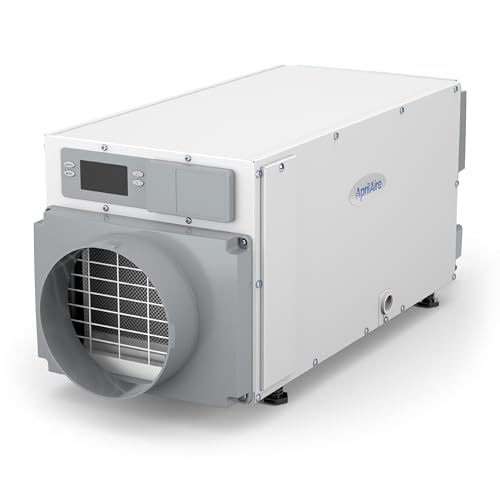
2. AprilAire E070 — The Smaller Drain-Only Crawl Space Unit
AprilAire lists the E070 at up to 70 pints per day for crawl spaces, basements and whole houses up to 2,200 sq ft. It has a built-in digital control on the inlet side that starts the unit automatically when humidity rises above the target, a washable MERV 8 filter and corrosion-resistant aluminum coils. The box includes 10-foot drain tubing and 8-inch duct collars, and the body measures 12.5 by 12.5 by 25 inches. AprilAire points to 40 to 60 percent relative humidity as its suggested range, while the EPA’s range is 30 to 50 percent and below 60 percent, so confirm your target with the installer.
There is no water tray. Setup, according to AprilAire, is to place the hose or set the unit over a drain, level it, plug it in and set the target. That works well with a floor drain or sump lower than the unit. Without one, a drain-only unit is the wrong tool, and a portable with a pump will fit better.
The page does not publish a noise rating, Wi-Fi control or a warranty term, so we state none of them. It also says “Professional install recommended.” Read the details in our AprilAire E070 profile.
3. AlorAir Sentinel HD55S — The Compact Cold-Tolerant Utility Unit
A low-profile, drain-hose unit with automatic defrost and an ENERGY STAR listing, for tight crawl spaces and utility basements where noise does not matter.
AlorAir quotes 120 pints at saturation and 55 pints per day at AHAM, while the ENERGY STAR listing shows 36.33 pints per day under its own test conditions and 379 kWh per year. These are three ways of measuring the same machine, which makes the HD55S a useful lesson in reading ratings. AlorAir lists a body of 19.2 by 12.2 by 13.3 inches, 41.7 lbs, up to 50 dBA, a 6.56 ft drain hose, a MERV-1 filter in the box and an operating range of 33.8 to 104 degrees F with automatic defrost. It also lists a 6-year limited warranty, with the first 2 years fully covered.
Two cautions. First, the AlorAir page we read describes the Wi-Fi version, while ENERGY STAR lists the standard HD55S as not connected capable, so do not count on app control. Second, drainage is by gravity only. The pump version is a different model that is not covered here.
It ranks third because the E080W and E070 list more capacity and the two portables add a pump, but the HD55S is the one with a published cold-weather range and decibel figure. See the AlorAir Sentinel HD55S profile.
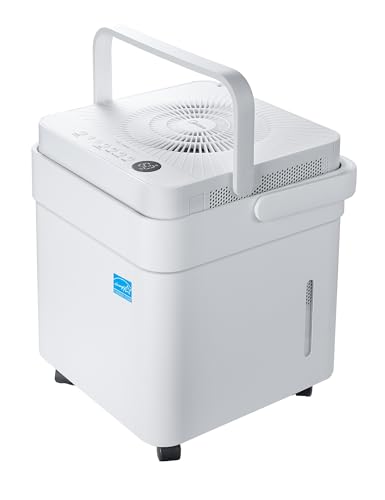
4. Midea Cube 50-Pint with Pump — The Compact Smart Portable
A 50-pint portable with a built-in pump, app and voice control and a body that nests for storage. For a basement or large room where the drain sits higher than the unit.
Midea lists model MAD50PS1QWT at 50 pints per day. The built-in pump allows continuous drainage out of a window or into a sink, and the included hose also lets it drain by gravity into a sink or floor drain. The lift-and-twist design switches between a nested mode for storage and an extended mode that Midea says offers more tank capacity. The unit rolls on four wheels with a built-in handle, weighs 41.54 lbs and measures 14.45 by 14.76 by 14.57 inches. Control is through the SmartHome app and voice assistants.
The gaps matter. Midea’s page lists no noise level, pump lift distance, operating temperature range or ENERGY STAR status for this model, and the warranty is 1 year. The page also mentions both 4,500 and 1,500 sq ft, so rely on the pint rating rather than square footage. Check the manual for the pump details before planning a long run.
hOmeLabs lists up to 50 pints per day at 80 degrees F and 60 percent relative humidity, and a maximum of 120 pints at 95 degrees F and 90 percent. It lists a 1.6-gallon removable tank, a built-in pump for continuous drainage, a drain hose option, Wi-Fi control, a full-tank alert, a washable filter, auto shut-off and a 1-year warranty. The body is 11 by 15.4 by 24.3 inches, with wheels and a handle.
The coverage claim of 7,500 sq ft is a marketing ceiling. ENERGY STAR’s sizing chart is a better guide: for a large room over 2,000 sq ft it suggests 30 or more pints per day when slightly to moderately damp, 40 or more when very damp and 50 or more when wet. A 50-pint unit fits one large, damp basement or open floor, not a whole house.
The pages we opened give no noise figure, pump lift or operating temperature range, so we leave them out. That keeps it at the bottom of this ranking despite a useful feature set. See the hOmeLabs 50-Pint with Pump and Wi-Fi profile for details.
Before You Buy: Drainage, Installation and Older Units
Drainage decides more purchases than capacity does. Walk the route the water will take. If a floor drain, sump or outdoor spot sits lower than the unit, a hose is enough. If the nearest sink or window sits higher, you need a pump, and the two 50-pint portables above list one. Any new outlet, circuit, duct connection or condensate pump should be done by a licensed electrician or HVAC contractor, and we do not give installation steps.
Portable 50-pint units are not meant to sit inside a crawl space. For a crawl space, the AprilAire units and the AlorAir HD55S are the models their makers list for that use.
One more point concerns older machines. The U.S. Consumer Product Safety Commission announced in August 2023 that about 1.56 million Gree-made dehumidifiers sold as Kenmore, GE, SoleusAir, Norpole and Seabreeze could overheat, smoke and catch fire, and told owners to stop using them. See the CPSC notice. An August 2021 CPSC notice covered about 2 million units made by New Widetech and sold under many well-known brand names, with a pro-rated refund as the remedy. See the CPSC notice. Both concern older units, so if you own an older dehumidifier, find its model number and check it against those pages. Nothing in this ranking is a statement that any listed model is free of recalls.
Recommendations by Use
Sealed crawl space or whole-house humidity problem: the AprilAire E080W, installed by a licensed contractor.
Smaller crawl space or a basement with a floor drain: the AprilAire E070.
Low-clearance crawl space or cold utility area: the AlorAir Sentinel HD55S, with automatic defrost.
We compare published specifications, not machines in a room. Several makers leave out warranty, noise or pump lift, and where that happens we say so rather than fill the gap. A pint number is a rating under stated conditions, so a unit in a cold or very wet space will remove less than its label. Square footage claims are loose across the category. Use pints per day, the dampness of the space and the drainage route as your main filters, and fix the source of the water before you size any machine.
Conclusion
The AprilAire E080W is first for capacity, ducting options, Wi-Fi and warranty, and it is the one to choose for a sealed crawl space or a large whole-house job. The AprilAire E070 is the smaller drain-only alternative. The AlorAir Sentinel HD55S earns third for its compact body, cold-weather range and ENERGY STAR listing. The Midea Cube 50-Pint with Pump and the hOmeLabs 50-Pint with Pump and Wi-Fi are the portables to compare when water has to travel uphill. Match capacity, drainage and installation to your space, and check any older unit you own against the CPSC recall pages.
ENERGY STAR's sizing chart suggests 40 or more pints per day for a very damp room over 2,000 sq ft and 50 or more when the space is wet or used for laundry. For a smaller, moderately damp room it points to a lower range. ENERGY STAR also says oversizing beats undersizing.
Why do old 70-pint labels and new 50-pint labels look so similar?
The DOE changed its test to cooler, more realistic conditions, and ENERGY STAR says the lower ratings started appearing in early 2020. Its rough conversion puts an old 70-pint rating at about 50 pints today, so the two labels can describe comparable machines. Compare current ratings with current ratings.
Do I need a pump or will a drain hose do?
A hose drains by gravity, so it only works if the drain, sink or outdoor spot is lower than the unit. If water has to go up to a sink or window, you need a built-in pump or a separate condensate pump. Have a licensed professional handle any permanent plumbing or electrical change.
Can a portable dehumidifier go inside a crawl space?
The portable 50-pint models in this ranking are not meant for inside a crawl space. The AprilAire units and the AlorAir HD55S are the ones their makers list for that use, and ducting or electrical work should be done by a licensed contractor or electrician.
What humidity level should I aim for?
The EPA says indoor humidity should stay below 60 percent, ideally between 30 and 50 percent. A dehumidifier helps keep relative humidity in that range, but it does not fix a leak, so find and repair the water source first.
Should I worry about an older dehumidifier?
The U.S. Consumer Product Safety Commission has announced recalls of older dehumidifiers from several makers. If you own one, find its model number and check it against the recall pages linked in this ranking before you keep running it.