We earn a commission if you buy through our links, at no extra cost to you.
Comparison
Best Small Dehumidifiers of 2026: Closet, RV & Bedroom
Three small dehumidifiers ranked for 2026: a 20-pint compressor unit, a quiet electric mini and a cordless rechargeable absorber, with specs and who each fits.
B By the Best Dehumidifier editorial team ·Published
At a glance
For a bedroom, apartment or bathroom, pick the Midea Cube 20-Pint, a compressor unit rated at 20 pints per day. The Eva-Dry EDV-1100 is a quiet 22-watt mini for closets and campers, and the cordless Eva-Dry E-333 recharges at an outlet for safes and cabinets.
Not every damp spot is a basement. A bedroom closet that smells like a gym bag, a camper that sits closed all winter, a gun safe where steel starts to spot, a bathroom without a good fan: these are small, enclosed problems, and a 50-pint machine is the wrong tool for most of them. This ranking covers the three small units on our site, from a compact room dehumidifier to a cordless absorber that fits in a drawer. We built it from published specifications. We read the product pages from Midea and Eva-Dry, along with ENERGY STAR and EPA guidance, and every figure below comes from those pages. If your problem is a wet basement, go to our main dehumidifier ranking instead.
How We Chose
Three things separate small dehumidifiers, and the first one matters most.
Technology. Compressor, thermoelectric (Peltier) and desiccant units behave very differently, and the section below explains how.
Space it is meant for. A bedroom is a thousand cubic feet or more. A closet is a few hundred. A safe is a few dozen. Match the rating to the space, not to the biggest number on the box.
How you get the water out. A tank you empty, a hose to a drain, or beads you dry out at an outlet. For a space you visit rarely, the routine is part of the product.
Beyond those, we look at noise (using only the figures makers publish), power source (outlet, 12V or none), warranty length and whether the maker gives a real capacity number. Where a maker does not publish something, we say so and do not guess.
Compressor, Peltier and Desiccant: What You Are Actually Buying
Compressor dehumidifiers work like a small air conditioner that does not cool the room. A fan pulls air across a cold coil, water condenses on it and drips into a tank or a hose. This is the technology behind the units rated in pints per day, and it is what ENERGY STAR means when it talks about efficient coils, compressors and fans. It moves the most water. The catches are noise, weight, and cold air: ENERGY STAR says frost can form on the coils below 65 degrees F and make the compressor cycle without removing moisture, which is why a unit meant for a cool space should be specified for lower temperatures. The Midea Cube 20-Pint is the compressor unit in this group.
Thermoelectric (Peltier) dehumidifiers replace the compressor with a solid-state cooling plate. There is no compressor and almost no moving parts, so these units are light, quiet and low in power draw. The trade-off is capacity: they remove far less water than a compressor unit, and generally less in cool air. Eva-Dry does not name the technology on the EDV-1100’s product page. It does list 22 watts, a figure far below a compressor, which is consistent with a thermoelectric design, so we describe it that way as an inference, not as a maker statement.
Desiccant dehumidifiers do not cool anything. Silica gel beads absorb water vapor, and when they are full you dry them out and reuse them. The Eva-Dry E-333 is of this kind, and Eva-Dry says it takes about 10 to 12 hours plugged into a 110-120V outlet to recharge. Because there is no condensation, a desiccant unit does not care about frost, but it holds a fixed amount of water, up to 13 oz in the E-333’s case, and then stops until you recharge it.
In short: a compressor unit dries a room, a thermoelectric mini unit nudges a closet, and a desiccant absorber guards a safe. Mixing those jobs up is the most common way to be disappointed.
What to Aim For
EPA says to keep indoor humidity below 60 percent, ideally between 30 and 50 percent relative humidity, and that controlling moisture is the key to controlling mold. A dehumidifier helps keep relative humidity in that range, but EPA is just as clear that you need to find and fix the water source. A hygrometer, which EPA describes as a small, inexpensive humidity meter available at many hardware stores, is the only way to know whether a closet or a camper is actually drier. Put one in the space before you buy anything, and read it again a week later.
Summary Table
#
Model
Type
Published capacity
Space (maker)
Water removal
Power
Noise (maker)
Warranty
1
Midea Cube 20-Pint
Compressor
20 pints per day
Up to 1,500 sq ft
Tank, or hose to sink or floor drain (no pump)
110-120V household power, SmartHome app
Not published
1 year
2
Eva-Dry EDV-1100
Electric mini unit (22 W)
Not published
Up to 1,100 cubic feet
Small tank with automatic shutoff
110-120V, optional 12V cord (sold separately)
About 33 dB
1 year
3
Eva-Dry E-333
Renewable silica gel
Up to 13 oz per cycle
Up to 333 cubic feet
Beads recharged at an outlet, about 10 to 12 hours
None while working; 110-120V to recharge
Silent in use (no moving parts)
5 years
1. Midea Cube 20-Pint — The Compact Compressor for Bedrooms and Apartments
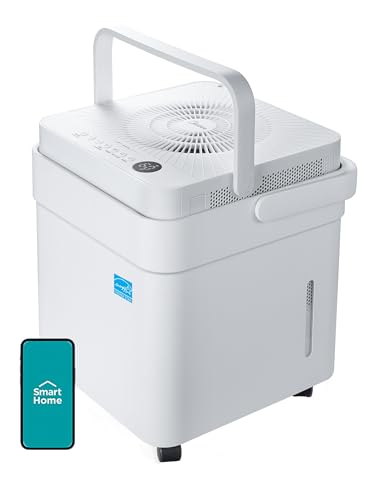
The Midea Cube 20-Pint leads this group for one reason: it is the only unit with a real, comparable capacity number. Midea lists 20 pints per day, and ENERGY STAR’s chart suggests 20 to 30 pints per day for a slightly to moderately damp space under 2,000 sq ft. That puts it at the bottom of the right band for a clammy bedroom, an apartment living room, a bathroom with weak ventilation or a small finished basement. The two Eva-Dry units cannot make that claim.
The design is convenient. Midea calls it lift-and-twist: nested, the unit is a compact cube you can tuck into a corner or a closet between seasons, and extended, the tank grows. It has four wheels and a built-in handle, and SmartHome app and voice assistant control let you adjust it from your phone, which is handy for starting it before you get home. For drainage, the included hose runs by gravity to a sink or floor drain. Midea’s spec table lists the built-in pump as No, so the drain has to sit lower than the unit.
What Midea does not publish matters. There is no decibel figure, no tank volume, no operating temperature range and no power draw on the page, and the warranty is 1 year. For a bedroom, that means you cannot compare noise with anything else, and a compressor unit does hum. For a cool basement or garage, check the manual before you rely on it, since ENERGY STAR’s warning about frost below 65 degrees F applies to compressor units in general.
Best for: bedrooms, apartments, bathrooms and small finished basements. Skip it if: the space is a closet or a safe (it is too much machine), or the basement is wet or large (look at the main ranking). Full specs are in the Midea Cube 20-Pint profile.
2. Eva-Dry EDV-1100 — The Quiet Mini Unit for Closets and Campers
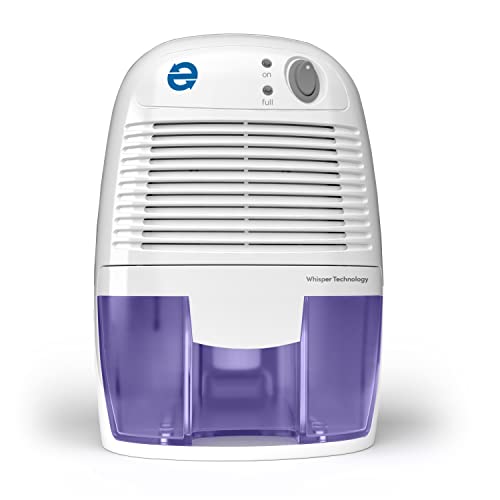
The EDV-1100 sits between the Midea and the cordless absorber. It plugs in, so it works continuously, and it is small enough to put on a closet shelf, in a pantry or in a camper. Eva-Dry lists approximately 33 dB, 22 watts, automatic shutoff when the tank is full and automatic restart after a power interruption. That last feature is a real advantage in a seasonal cabin or a parked RV, where a tripped breaker would otherwise leave the unit off for weeks.
For travel and boats, Eva-Dry says the unit can run from a 12V DC cigarette lighter outlet with its optional EDV-12V cord, which is sold separately. Check that the listing you buy includes it before you plan on it. Eva-Dry also gives a 1-year limited warranty and asks for registration within 30 days.
Be realistic about the numbers. Eva-Dry’s 1,100 cubic feet works out to about 137 sq ft of floor with an 8 ft ceiling, which sounds like a bedroom on paper. But Eva-Dry publishes no pints-per-day rating and no tank size, and at 22 watts it is far from compressor territory. We treat it as a closet, pantry, small bathroom and RV unit, and we would expect it to slow down in cool rooms, since the maker gives no operating temperature range. There is no hose and no pump: you empty the tank.
Best for: closets, pantries, small bathrooms, campers, boats. Skip it if: you need to dry a whole bedroom, or the space is regularly below 65 degrees F. See the Eva-Dry EDV-1100 profile for details.
3. Eva-Dry E-333 — The Cordless Absorber for Safes, Drawers and Cabinets
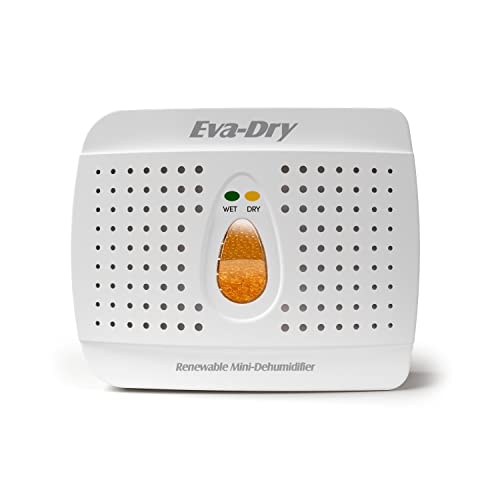
The E-333 ranks third not because it is a poor product but because it solves the narrowest problem. Eva-Dry describes a renewable mini dehumidifier with no motor, no moving parts and no power draw while it works. The beads change color as they fill. When they do, you plug the unit into a 110-120V outlet for about 10 to 12 hours until they return to their original color, then put it back. Eva-Dry lists a 5-year limited warranty, the longest in this group.
The numbers set the limits. Up to 333 cubic feet is about 41 sq ft of floor with an 8 ft ceiling, a walk-in closet at most, and 13 oz is a little under a pint. A compressor unit rated at 20 pints per day removes that much in a short time and keeps going. The E-333 stops when its beads are full. That is fine for a gun safe, a drawer of collectibles, a cabinet, a car or a stored boat, where the volume is small and the air is mostly sealed. In those places there is often no outlet, which is the one place a cordless unit wins outright.
The routine is the cost. A closet you open every day lets in fresh humid air, so the beads fill faster, and recharging is a chore you must remember. Eva-Dry gives no recharge interval, so you learn it by watching the beads.
Best for: gun safes, safes, cabinets, drawers, closets without an outlet, RVs in storage. Skip it if: you want something that runs unattended for months or dries a room. Read the Eva-Dry E-333 profile for more.
Which One for Which Space
Dehumidifier for a closet. Start with the EDV-1100 if there is an outlet in or near the closet and you want it to run on its own. Use the E-333 if there is no outlet or you prefer silence and no cord. A reach-in closet is much smaller than either rating, so both fit.
Rechargeable dehumidifier for a closet. The E-333 is the only rechargeable option on this site. Plan a recharge spot near an outlet, and a second routine: check the beads when you check the closet.
Dehumidifier for a safe or gun safe. The E-333 is the match, since Eva-Dry lists safes and storage boxes among its uses and a safe has no outlet. Put it where it cannot tip against the contents and follow Eva-Dry’s instructions.
Dehumidifier for an RV or camper. The EDV-1100 is the natural choice, with its auto restart and the optional 12V cord. The E-333 works for storage, especially if you can take it inside to recharge. A bigger camper that stays damp may need the Midea, but it is a 33 lb unit that needs household power.
Small dehumidifier for a bathroom. If the bathroom is the size of a closet, the EDV-1100 is in range. A bathroom with a daily shower, or one in an apartment where humidity runs high everywhere, is a better match for the Midea Cube 20-Pint. Whichever you use, keep it clear of splashing water, and plug it in as its manual directs. Also run the bathroom vent fan, which ENERGY STAR recommends for removing humidity at the source.
Small dehumidifier for a bedroom or apartment. The Midea. It is the only one here with a pints-per-day rating, and the two Eva-Dry units are not sized for a full room. Midea publishes no noise figure, so think about where it sits relative to the bed.
When a Small Unit Is Not Enough
Small units fail in predictable ways. A space that feels damp all year, shows damp spots on walls or floors, or doubles as a laundry area belongs in ENERGY STAR’s higher bands: 25 to 40 pints per day when it is very damp and 30 to 50 when it is wet, for a room under 2,000 sq ft. None of the three units here is in that range. For a basement, step up to a 40- or 50-pint model, as covered in our main dehumidifier ranking. And EPA says to dry water-damaged areas within 24 to 48 hours and to fix the source: an absorber is not a repair.
Before You Buy
Measure first. An inexpensive hygrometer, as EPA describes, tells you whether you have a problem at all.
Check the model number. On the Midea listing look for MAD20S1QWT, so you get the 20-pint unit and not a pump model.
Plan the drain. Gravity needs a sink or floor drain lower than the unit.
Match the warranty to the use. 1 year for the Midea and the EDV-1100, 5 years for the E-333, per the makers.
Replacing an old unit? Older dehumidifiers from many brands have been the subject of safety recalls. Check the model number of an old unit on the CPSC recall pages before you plug it back in.
Our Recommendations by Use
Bedroom, apartment or small basement: Midea Cube 20-Pint.
Closet, pantry, small bathroom or camper with an outlet: Eva-Dry EDV-1100.
Safe, drawers, cabinets or a closet with no outlet: Eva-Dry E-333.
Conclusion
The right small dehumidifier depends on the size of the space and whether you can plug in. The Midea Cube 20-Pint ranks first because it is the one unit with a published capacity that matches a real room. The Eva-Dry EDV-1100 is second for closets and campers, where quiet and auto restart count more than capacity. The Eva-Dry E-333 is third and works well in its own small corner: a safe or a drawer. If your problem is bigger than any of them, go to our main ranking.
For a closet with a nearby outlet, the Eva-Dry EDV-1100 is a quiet plug-in mini unit rated by Eva-Dry for up to 1,100 cubic feet. For a closet with no outlet, the cordless Eva-Dry E-333 absorbs moisture with silica gel and recharges at an outlet. A reach-in closet is far smaller than either rating, so both are within range.
Is there a rechargeable dehumidifier for a closet or a gun safe?
Yes. The Eva-Dry E-333 is a renewable silica gel unit. Eva-Dry says it needs no power while it works and recharges by plugging into a 110-120V outlet for about 10 to 12 hours, until the color-changing beads return to their original color. It lists safes and storage boxes among its uses.
What is a good small dehumidifier for a bathroom?
A closet-sized bathroom can work with the Eva-Dry EDV-1100. A bathroom where the shower runs daily, or a bathroom that is part of a damp apartment, is closer to the Midea Cube 20-Pint's 20 pints per day. Keep any unit away from splashing water and follow its manual.
Can I use a dehumidifier in an RV or camper?
The Eva-Dry EDV-1100 can run on 110-120V, or from a 12V DC outlet with Eva-Dry's optional EDV-12V cord, which is sold separately. The cordless E-333 needs no power while working, but you must take it to an outlet to recharge. A compressor unit such as the Midea Cube 20-Pint needs household power and is larger for a small rig.
What is the difference between compressor, Peltier and desiccant dehumidifiers?
A compressor unit cools a coil and condenses water out of the air, and it is the type rated in pints per day. A thermoelectric (Peltier) unit does the same job with a solid-state cooling plate, which makes it quiet and low-power but weaker, especially in cool air. A desiccant unit such as the E-333 uses silica gel, holds a fixed amount of water and must be dried out to be reused.
Will a small dehumidifier fix a damp basement?
Usually not. ENERGY STAR suggests 20 to 30 pints per day for a slightly to moderately damp space under 2,000 sq ft, and more as it gets wetter. The two Eva-Dry units are far below that class. For a basement, see our main ranking.