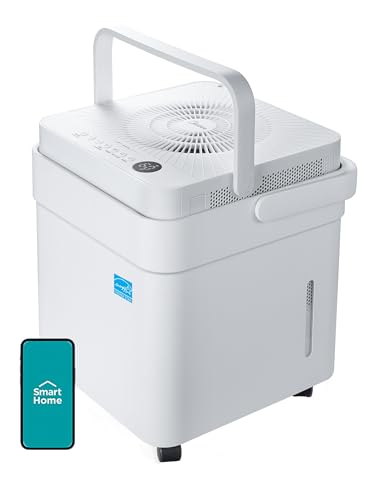
The Midea Cube 20-Pint, model MAD20S1QWT, is the step between a closet mini unit and a full basement machine. It is a compressor dehumidifier rated at 20 pints per day, small enough to carry between rooms, and with an app. This profile covers what Midea publishes, how to read that 20-pint figure against ENERGY STAR’s sizing chart, what the drainage really offers and where a unit this size falls short. Specs come from Midea’s own product page.
What Midea Says About the Cube 20-Pint
According to Midea:
- Model: MAD20S1QWT, white.
- Capacity: 20 pints per day.
- Room size: up to 1,500 sq ft; Midea calls it suited to living rooms, basements and garages.
- Design: lift-and-twist cube that works nested for storage or extended for a larger tank.
- Drainage: an included hose for continuous drainage into a sink or floor drain; Built-in Pump: No.
- Control: SmartHome app and voice assistant devices.
- Portability: lightweight frame, four wheels and a built-in handle.
- Size and weight: 13.5 inches wide, 13.5 inches deep, 13.39 inches high; 33.07 lbs.
- Warranty: 1 year.
Midea’s page does not list a noise figure, tank volume, operating temperature range or power draw. We leave those out rather than guess.
Reading the 20-Pint Rating
Pints per day is how dehumidifiers are sized in the US, and the number depends on the condition it is measured under. ENERGY STAR notes that capacity ratings have changed in recent years, so a 20-pint figure is not directly comparable with the older labels printed on units sold years ago. Compare current models by their stated pints per day, and not by the square footage on the box.
ENERGY STAR gives a simple sizing chart. For a small-to-medium space under 2,000 sq ft it suggests:
- 20 to 30 pints per day when the space is slightly to moderately damp, with a musty smell that comes and goes, at 50 to 75 percent relative humidity.
- 25 to 40 pints per day when it is very damp, with damp spots on walls and floors, at 75 to 90 percent.
- 30 to 50 pints per day when it is wet, or laundry drying adds load.
ENERGY STAR also says it is better to oversize than undersize. A 20-pint unit sits at the bottom of the first band, so it matches a bedroom, an apartment, a bathroom or a mildly damp finished basement. Midea’s 1,500 sq ft is about the largest space it will cover under ideal conditions. If your basement feels damp year-round, shows damp spots or doubles as a laundry area, a unit rated for 40 to 50 pints, such as those in our main ranking, is the safer buy.
What EPA Says to Aim For
EPA advises keeping indoor humidity below 60 percent, ideally between 30 and 50 percent, and says moisture control is the key to mold control. ENERGY STAR puts the generally optimal range for a building at 30 to 50 percent, and 30 to 40 percent in colder climates during the heating season to prevent window condensation. A dehumidifier helps with that goal, but EPA is clear that you also need to find and fix the water source. A 20-pint unit is a tool for managing humidity, not for drying a flooded room.
A plain hygrometer tells you whether the unit is working. Hang it near the dehumidifier, as ENERGY STAR suggests, and set the humidity target on the unit to fall in that range.
Drainage: Hose Yes, Pump No
The Midea Cube 20-Pint and its 50-pint sibling with a pump look alike, so it is easy to mix them up. Midea’s own spec table lists this one with Built-in Pump: No. What you get is the removable tank and a hose for gravity drainage.
That works well if the dehumidifier can sit on a shelf, a stand or the floor above a sink or a floor drain. Water flows downhill, so the outlet has to be higher than the drain. If your drain is across the room and above the unit, or if you want to route water up and out a window, you need a model with a pump. If you want no hose at all, emptying the tank becomes a daily routine. Midea does not publish the tank volume, so expect a small room to need emptying about once a day in humid weather.
Using It in a Bedroom, Apartment or Bathroom
This is where the Cube 20-Pint earns its place:
- Bedroom. At 20 pints per day it is the right size for a bedroom that feels clammy, especially a ground-floor or basement bedroom. Midea lists no noise rating, so consider where you will put it relative to the bed.
- Apartment. Four wheels and a 33 lb body let it move from room to room, and the app lets you start it before you get home.
- Bathroom. It will help in a bathroom where a fan alone is not enough. Keep it away from splashing water, and plug it in following Midea’s manual.
- Small basement. A finished basement of a few hundred square feet with mild dampness is a reasonable match. A wet unfinished basement is not.
For tiny spaces, a unit this size is more than you need. A closet, a safe or a camper is better served by the Eva-Dry EDV-1100 or the cordless Eva-Dry E-333.
Where It Falls Short
- No pump. Gravity drain only.
- Limited published specs. No dB, tank size, power or operating temperature range, so check the manual before you buy for a cold space. ENERGY STAR warns that frost can form on a compressor unit’s coils when air temperature drops below 65 degrees F and hurt performance; a cold garage or unheated basement is the case to watch.
- Short warranty. Midea lists 1 year.
- Capacity. 20 pints is a small number for a large, wet or laundry-heavy space.
Who It Suits
- Renters and homeowners with a bedroom, apartment or bathroom that feels damp.
- People with a small, finished basement and a nearby sink or floor drain.
- Buyers who want app and voice control and a unit that rolls and stores nested.
Who Should Look Elsewhere
- A damp, large or wet basement: a 40- to 50-pint unit, covered in our main ranking.
- Closets, safes, drawers and RVs: the Eva-Dry EDV-1100 or Eva-Dry E-333.
- Pumped or window drainage: a model that lists a built-in pump.
Buying Notes
- Check the model number MAD20S1QWT on the listing so you get the 20-pint unit and not a pump model.
- Read the manual for the plug, outlet and placement instructions, and keep the unit away from walls and curtains so air can circulate.
- Plan where the drain hose will run before you set it up.
- Older dehumidifiers from many brands have been the subject of safety recalls. If you are replacing an old unit, check its model number on the CPSC recall pages first.
Bottom Line
The Midea Cube 20-Pint is a compact, portable compressor dehumidifier with a published 20 pints per day, a lift-and-twist tank and app control. It is a good fit for a bedroom, apartment, bathroom or small basement, and a poor fit for a large or wet one. Use the button below to see current pricing on Amazon.
For how it ranks against the other small units, see our small dehumidifier ranking for 2026.
See price on Amazon
Sources